

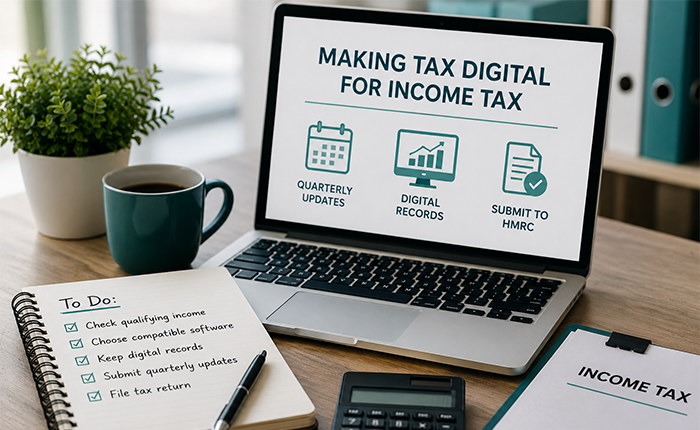
Making Tax Digital for Income Tax is now a reality for hundreds of thousands of sole traders and landlords across the UK.
The first phase came into effect on 6 April 2026, but with further businesses and landlords joining the system in 2027 and 2028, now is a good time to understand whether Making Tax Digital (MTD) applies to you, and what you need to do.
Here’s a straightforward guide to the current rules.
Who Needs to Use Making Tax Digital?
MTD for Income Tax is being introduced gradually according to your qualifying income from self-employment and property.
Under the current HMRC timetable:
- If your qualifying income for 2024/25 was over £50,000, you should have started using MTD from 6 April 2026.
- If your qualifying income for 2025/26 was over £30,000, you will need to use MTD from 6 April 2027.
- If your qualifying income for 2026/27 is over £20,000, you will need to use MTD from 6 April 2028.
Importantly, qualifying income means your total gross income from self-employment and property before expenses and tax, rather than your profit. If you have more than one source of self-employment or property income, the relevant income is considered together when determining whether you exceed the threshold.
What Does Making Tax Digital Actually Mean?
If MTD applies to you, you’ll need to use compatible software to keep digital records of your self-employment or property income and expenses.
Every three months, your software uses those records to create a summary of your income and expenses. You then send a quarterly update to HMRC for each self-employment or property business you have. These updates are summaries rather than additional tax returns, and you don’t need to make accounting or tax adjustments before submitting them.
At the end of the tax year, you’ll check the information held in your software, add any other relevant income, gains, reliefs or allowances and submit your tax return using compatible software.
Already Using MTD? What Happens Next?
For those who entered MTD in April 2026, the first quarterly update deadline was 7 August 2026, with subsequent quarterly deadlines falling on 7 November, 7 February and 7 May.
HMRC has introduced a softer approach to quarterly-update penalties during this first year. There are no penalty points for missing quarterly update deadlines during the 2026/27 tax year, although the updates still need to be submitted before you can complete your tax return. Penalties can still apply to late tax returns and late tax payments.
Starting in April 2027? Don’t Leave It Until the Last Minute
If your qualifying income for 2025/26 was above £30,000, your MTD obligations begin on 6 April 2027.
Although that may seem some way off, preparing early can make the transition considerably easier. You’ll need compatible accounting software and a suitable system for maintaining digital records, so it’s worth reviewing how you currently keep your accounts well before the deadline.
It also provides an opportunity to get used to the new process rather than trying to change your bookkeeping arrangements at the last minute.
Are There Any Exemptions?
Yes. Some people are automatically exempt, while others can apply to HMRC for an exemption.
For example, an exemption may be available where someone is digitally excluded and it isn’t reasonable for them to use digital tools to maintain records or submit information to HMRC. Being exempt from MTD doesn’t remove the requirement to report income and gains through Self Assessment.
Getting Ready for Making Tax Digital
MTD represents a significant change in how many sole traders and landlords manage and report their finances, but it doesn’t need to become an administrative headache.
Understanding when the rules apply to you, putting suitable software in place and keeping accurate digital records can make the transition much smoother.
At HJ Accountants, we can help you understand whether Making Tax Digital applies to you, prepare for upcoming deadlines and ensure your accounting systems are ready for the new requirements.
If you’re unsure when you need to start using MTD for Income Tax, speak to the HJ Accountants team for straightforward advice and support.